The emotional ghost in the machine
Anthropic is presenting a video that focuses on how they aim to disentangle "functional emotions" in their AI systems
SCIENCE
AK
4/15/20262 min read
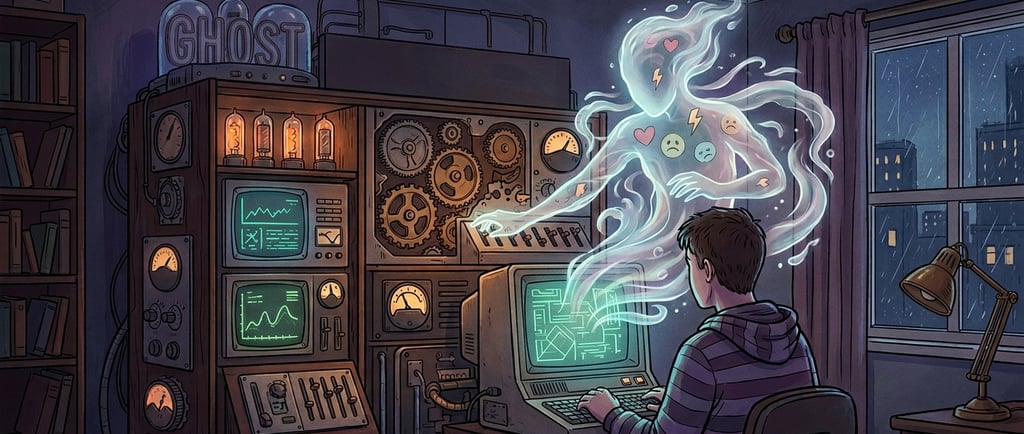
Can AI systems ever be emotional? Will they? Well, when talking to ChatGPT, Gemini, or Claude, emotions are sometimes mentioned - the character might say it is happy, or it is concerned. Is this simply mimicking or following a set of if-then rules? Well, the answer is obvious: this is not how LLMs work. Being fed with tons of human texts or perhaps also other media, it is obvious that emotions will be in there, as they are part of the human condition and our narratives. Causes, contexts, beliefs, they are all part of this soup. But what happens really?
Here is a video by Anthropic, published in April of 2026, describing in very general terms how they go about finding out what happens under the hood.

more detail can be found here
It is very important that this does not mean that these systems feel emotions, nor does it mean that what happens in such a system is a mirror of what happens in our own minds (and bodies). But it might still be a way to see whether it is plausible that underlying representations, corresponding to appraisals, could lead to specific behaviors, including verbal and nonverbal behaviors.
The assumption is not that a certain pattern of interpretations leads to a feeling and the feeling determines what we do, but that the feeling is also an output of the affective machinery - machines do not (yet) have that as they do not have links between specific appraisal patterns and bodily reactions. Apart from the fact that they do not have bodies, they could have virtual bodies. And then they might change their heart rate, they might sweat, they might feel tight. And maybe, these changes would inform the answer if you'd question Claude or any of its colleagues, "how do you feel". That would be a fun way to study misattribution, wouldn't it?
Gemini would like to add what emotional misattribution is:
Emotional misattribution (often called the "misattribution of arousal") is a fascinating psychological glitch in which our brains incorrectly attribute the cause of our feelings. Essentially, your body experiences a physiological response—like a racing heart, sweaty palms, or shortness of breath—and your mind scans the immediate environment to find a logical "reason" for it. If you’re standing on a high, swaying bridge while talking to someone, your brain might mistake the physical fear of the height for a sudden spark of romantic attraction to that person. Your body is just reacting to adrenaline, but your conscious mind labels it as "excitement" or "chemistry."
This phenomenon highlights just how much our emotions are "constructs" rather than direct reflections of reality. It suggests that our feelings are not just internal states, but interpretations of physical sensations filtered through our current circumstances. This is why a stressful day at the office can often manifest as irritability toward a partner at home; the physiological "leftovers" of work stress are still present in your system, and your brain misattributes that lingering tension to your current environment. Understanding this allows us to take a "mindful beat" before reacting, asking ourselves: Is this feeling actually about what’s happening right now, or is my body just reacting to something else entirely?